Choosing a canvas is probably one of the most difficult tasks for an amateur artist. The canvas is the basis for Your masterpiece. And if you choose the wrong canvas, then the masterpiece may turn out to be “wrong” or simply fail. Choosing a canvas, you seem to figure out the technique and manner of painting already. So, what is the secret? Let’s learn more about a canvas is and how to choose it correctly.
When you choose a canvas, pay your attention to the material. I expect you see how many canvases art shops and online stores offer now? You should not take a first that comes along, a little knowledge will help You decide easily and quickly.
What material should we choose for oil paints, cotton or linen?
Cotton canvas:

Nowadays cotton canvases are probably the most common and are in demand. Choosing a cotton canvas, you won’t lose on it, this material is “malleable”, it is pleasant and convenient to paint any technique. As far as I know, the first cotton canvas started to use in the USA in the past century. As you know, they don’t have a century yet, so it is impossible to check how durable they are.
The benefit of choosing a cotton canvas:
- cotton canvas does’nt have such a high price in contrast to linen
- with a good stretch, it is good and convenient painting;
If we talk about the deficiencies of cotton canvas:
- susceptible to moisture absorbing;
- susceptible to mechanical damage;
- cotton is susceptible to sagging over the years;
Linen canvas:

Choosing a linen canvas, you repeat the fate of old masters who painted their masterpieces only on linen canvas. Flax has established itself as the best material for canvas. Paintings on linen canvases have been painted for more than a century, in contrast to relatively new cotton. The choice of linen canvas for painting is considered to be “noble” and the best among the artists.
If we talk about the benefits of linen canvas, we should note:
- linen does not absorb moisture, unlike cotton;
- is less susceptible to sagging over the years;
- not so susceptible to mechanical damage;
But what about deficiencies? Is there any concerning linen canvas? There are:
- linen canvas is much more expensive in contrast to cotton.
- its weight is higher than a cotton (if we talk about exhibitions and sending paintings by delivery services);
Synthetic canvas, choose or not?

I have to be honest, at the time of writing this article, I’ve never used a canvas made of synthetic fiber. Let me tell you something else, in the store where I buy my art supplies, I have never seen a synthetic canvas. Of course we can say that it is an innovation of the new era of painting, and most art shops don’t want to risk. Synthetic canvas, how can you choose this, lot of you will be thinking. But time passes and no one could even think of good synthetic brushes before. You can see a bit of the same thing happening with synthetic canvases.
Benefits of synthetic canvases:
- I think no one could deny that synthetics don’t rot and don’t absorb moisture;
- a synthetic canvas will be lighter than a canvas made of natural materials;
Deficiencies of synthetic canvases:
- as the artists say, they have not passed the test of time;
- not many people who was using it ( I’ve never painted on it), That’s why I can’t say anything concerning this canvas.
- There are also combined canvases: cotton-linen, cotton-synthetics, I’m a little skeptical about that. Different materials behave differently and can behave unpredictable in variant of combination.
What grain of the canvas we need for good quality painting?

Each canvas is indicated by grain characteristics. How to deal with it and which is better?
There are three types of canvas grain:
- Fine canvas. Such canvases are distinguished by their almost smoothness, the graininess of the canvas is very small, and it is not popular now. It’s very good for staining technique applying one coat of paint after the other. It is a good choice if you want to paint a portrait.
- Medium canvas. There is a canvas with an average grain, it is concidered to be one of the most popular. it is convenient for pasty and staining techniques.
- Coarse canvas. Is perfect for working with a palette knife. Such a canvas holds textured painting well without visible deformation.
How we should choose a canvas, primed or not?

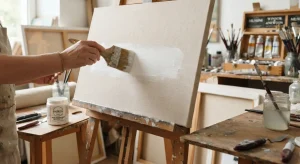
The choice is clear, your canvas must be primed in order to painting oil paints. If your canvas is not primed it’s completely unsuitable for oil painting, it is 100%. But as usual, you’ve got a choice: you can buy a primed canvas, or not primed with the possibility to do it yourself. How? You can buy an art priming for your canvas to be “refined”.
Canvas on a stretcher or canvas on cardboard, which type to choose?

it’s always your choice:
- the canvas on the stretcher, you can adjust its stretch. You can remove your canvas during transportation, and then stretch it again. The canvas on the stretcher has some kind of “springiness” due to the stretch while you’re painting. Personally, I really like that.
- canvas on cardboard, it’s the same canvas only glued to cardboard, it’s thinner (there is no stretcher) and costs less than canvas on a stretcher. You will not be able to adjust the stretch of the canvas, but it will not sag over time.
Also I need to mention a plywood, fiberboard and wood that are used by artists at the studio or on the open-air. Excellent material, but as you understand it is short-lived, you can paint on it, but pay attention to the primer of this material. Plywood can delaminate over time, and fiberboard can give waves of moisture. In this case, the tree is practical material if it is well primed and protected. Do you remember wooden icons of Saints that have been visited for ages.
Of course, first of all, thelife of picture depends on what condition it is, how changeable climate and the level of moisture in the area where it hangs. The material of canvas can significantly prolong or shorten life of your masterpiece.


Very interesting article! I think would be very helpful for everyone who creates or buys art 🙂
Thank you! 🙂